Part 2
The Mustard Seed Mystery
How Does the Kingdom of Heaven Begin?
Keywords: Kingdom of Heaven, Mustard Seed Parable, Kingdom of God, Word of God, Jesus Christ, Biblical Symbolism, Christian Theology, Gospel of Matthew, Gospel of Luke, Heaven Explained
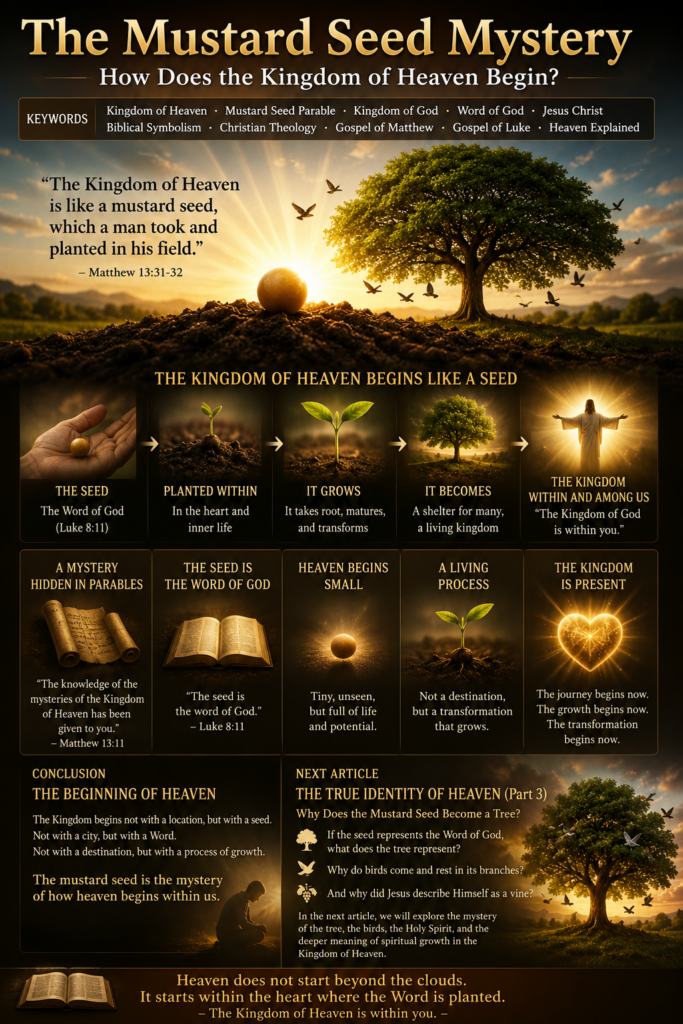
Why Did Jesus Compare Heaven to a Mustard Seed?
When most people think about heaven, they imagine a place.
A destination.
A realm beyond death.
Perhaps a city of gold.
Perhaps a paradise beyond the clouds.
Yet Jesus described heaven in a surprisingly different way.
Instead of speaking about a distant location, He compared the Kingdom of Heaven to something extremely small.
A mustard seed.
In Matthew 13:31-32, Jesus said:
“The Kingdom of Heaven is like a mustard seed, which a man took and planted in his field.”
At first glance, the comparison seems strange.
How can heaven be a seed?
A seed is not a city.
A seed is not a kingdom.
A seed is not a place where people go after death.
Yet Jesus deliberately chose this image.
Why?
The answer may completely change how we understand the Kingdom of Heaven.

Heaven Is Described as a Mystery
Before explaining the mustard seed, we must remember something important.
Jesus repeatedly taught that the Kingdom of Heaven was a mystery.
In Matthew 13:11, He told His disciples:
“The knowledge of the mysteries of the Kingdom of Heaven has been given to you.”
Notice what Jesus did not say.
He did not say the Kingdom was obvious.
He did not say everyone understood it.
He called it a mystery.
Something hidden.
Something concealed beneath symbolic language.
This idea appears throughout Scripture.
Psalm 78 declares:
“I will open my mouth in parables, I will utter hidden things, things from of old.”
According to the biblical narrative, hidden truths were intentionally placed within symbols and parables.
Therefore, if heaven is a mystery, perhaps we should not expect Jesus to describe it in literal language.
Perhaps the mustard seed itself is a symbolic key.
The Seed Is the Word of God
Fortunately, Scripture provides its own interpretation.
In Luke 8:11, Jesus explains another parable:
“The seed is the word of God.”
This statement is crucial.
The seed represents God’s Word.
Divine truth.
Spiritual revelation.
A message from God.
Suddenly the mustard seed begins to make sense.
If the seed represents the Word of God, then the Kingdom of Heaven begins with the planting of that Word.
But where is the seed planted?
Not in the sky.
Not in a distant heavenly realm.
It is planted within human beings.
Within the heart.
Within the mind.
Within the inner life.
This means the Kingdom begins much closer than most people imagine.
It begins within.
Why Does the Seed Need to Grow?
One of the most important details in Jesus’ parable is that the seed does not remain a seed.
It grows.
This growth is essential.
A seed contains life, but that life must develop.
It must mature.
It must transform.
The same principle applies to the Word of God.
Receiving truth is only the beginning.
The truth must grow.
It must take root.
It must shape a person’s character, understanding, and way of life.
Jesus describes the Kingdom not as an instant event but as a process.
A journey.
A transformation.
Something living and developing.
This is very different from the common assumption that heaven is merely a place people enter after death.
The Kingdom begins before death.
It begins when the seed is planted.
Heaven Begins Small
Another remarkable feature of the mustard seed is its size.
It is tiny.
Almost insignificant.
Easy to overlook.
Yet Jesus says that from this tiny beginning something extraordinary emerges.
The Kingdom does not arrive with dramatic force.
It begins quietly.
A truth heard.
A realization received.
A change of heart.
A new understanding.
History’s greatest transformations often begin this way.
Small beginnings.
Invisible growth.
Profound results.
The Kingdom of Heaven follows the same pattern.

The Kingdom Is a Living Process
Many people think of heaven as a destination.
Jesus often describes it as a living process.
A seed is alive.
It grows.
It develops.
It changes form.
The Kingdom therefore appears to be dynamic rather than static.
Something unfolding.
Something becoming.
Something gradually revealed.
The mustard seed teaches that heaven is not merely about where life ends.
It is about what life becomes.
This may explain why Jesus spent so much time speaking about transformation rather than geography.
His focus was not simply on a future destination.
His focus was on the growth of God’s Word within human beings.
Why This Matters
If heaven begins with the Word of God planted within a person, then the Kingdom is not merely a future hope.
It becomes a present reality.
The journey begins now.
The growth begins now.
The transformation begins now.
The Kingdom is not simply something we wait for.
It is something that begins to develop within us.
This perspective helps explain why Jesus could say:
“The Kingdom of God is within you.”
The seed had already been planted.
The process had already begun.
Conclusion: The Beginning of Heaven
The mustard seed reveals one of the most important principles in Jesus’ teaching.
The Kingdom of Heaven begins small.
The seed represents the Word of God.
The Word is planted within people.
It grows.
It develops.
It transforms.
The Kingdom therefore begins not with a location, but with a seed.
Not with a city, but with a Word.
Not with a destination, but with a process of growth.
This is the mystery hidden within the mustard seed.
Next Article
The True Identity of Heaven (Part 3)
Why Does the Mustard Seed Become a Tree?
If the seed represents the Word of God, what does the tree represent?
Why do birds come and rest in its branches?
And why did Jesus describe Himself as a vine?
In the next article, we will explore the mystery of the tree, the birds, the Holy Spirit, and the deeper meaning of spiritual growth in the Kingdom of Heaven.